Relationships & Personality
Every NPC in RPG Mode has a relationship score with your character, plus 7 personality traits that define who they are. These two systems work together to create a social layer where your choices and your character’s personality genuinely matter.
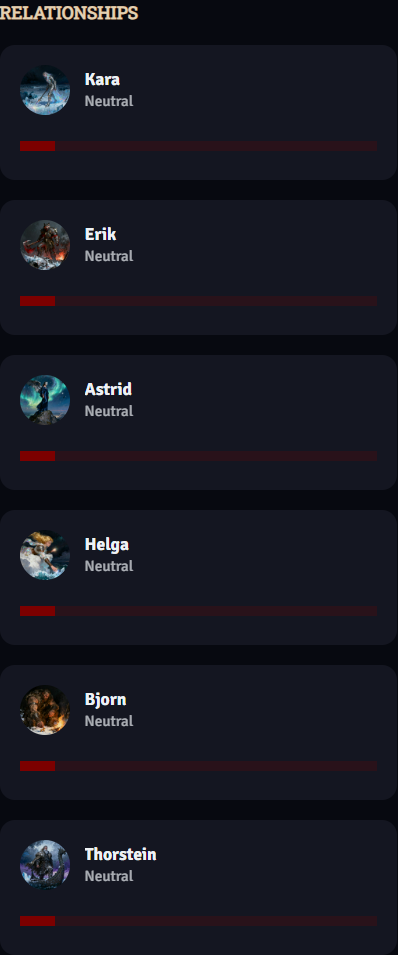
Relationship score
Section titled “Relationship score”Each NPC you meet has a relationship score on a 0–100 scale:
| Range | What it means |
|---|---|
| 80–100 | Deep bond — trust, admiration, or intense attachment |
| 50–79 | Positive — friend, ally, growing connection |
| 30–49 | Neutral — acquaintance, cautious coexistence |
| 10–29 | Strained — tension, distrust, past conflict |
| 0–9 | Hostile — open antagonism |
The colored progress bar in the sidebar gives you a quick visual read:
- 🟢 Green — neutral to positive (30–79)
- 🟡 Yellow/Orange — strained (below 30)
- 🔴 Red — very high intensity (above 80)
What affects relationship scores
Section titled “What affects relationship scores”- Your actions and dialogue — How you treat an NPC directly affects their score each turn
- Charisma stat — Higher Charisma amplifies positive relationship gains and softens losses
- Personality compatibility — If your traits closely match an NPC’s, positive interactions give a small bonus
- Quest completion — Successfully completing quests involving a specific NPC often boosts their score
The 7 personality traits
Section titled “The 7 personality traits”Every character — both your player and NPCs — has 7 traits measured on a scale:
| Trait | What it measures |
|---|---|
| Wisdom | Depth of insight and sound judgment |
| Generosity | Willingness to give and sacrifice for others |
| Integrity | Honesty, keeping promises, moral consistency |
| Empathy | Understanding and sharing others’ feelings |
| Courage | Willingness to act despite fear or risk |
| Temperance | Self-control, moderation, emotional balance |
| Influence | Natural ability to affect others’ beliefs and decisions |
Each trait sits on a spectrum. The displayed name for each trait changes based on where a character falls — a very high Courage score might read as “Reckless Bravado” while a moderate score reads as “Steady Resolve.”
Personality compatibility
Section titled “Personality compatibility”When relationship changes are calculated each turn, the system also checks how aligned your behavior are with the NPC’s personality traits. Characters with similar values build bonds faster than those with opposite personalities.
A perfect alignment gives the maximum compatibility bonus. Completely opposite personalities give no bonus. This adds natural social dynamics — a highly empathetic character will bond faster with empathetic NPCs, while two impulsive characters might find kinship in their shared recklessness.
💡 Tip: You can check an NPC’s personality traits by viewing their character sheet in the Characters tab. Choosing to build relationships with NPCs who share your traits is a valid strategic choice in RPG Mode.
Personality traits in the story
Section titled “Personality traits in the story”Personality traits don’t just affect numbers — the AI actively uses them when writing NPC dialogue and behavior:
- A high-Integrity NPC won’t help your character break a promise, even for a good reason
- A low-Temperance NPC might lash out when under pressure
- A high-Empathy NPC will notice when you’re struggling and react to it
- A high-Influence NPC will actively try to shape your decisions
Charisma in practice
Section titled “Charisma in practice”Your Charisma stat is the primary RPG stat tied to relationships. Investing Level Up Points in Charisma is the most direct way to improve your social outcomes across all NPCs.
Viewing relationships
Section titled “Viewing relationships”Relationships appear in the Stats tab (⚡) of the RPG Sidebar, below the stats grid. Each NPC shows their portrait, name, role, and a colored relationship progress bar. The bar updates after each turn where you interact with that NPC.